From Monochrome to Full Color: Margaret's Watercolor Drapery Studies
Margaret recently sent us a report with beautiful watercolor studies completed as one of 100 practical assignments of the Watercolor Academy Personal Tutoring course.
The assignment begins with monochrome studies and progresses toward more complex full-color compositions. Working in monochrome allows the artist to concentrate on tonal values, the direction of folds, and the three-dimensional structure of fabric without being distracted by color. Full-color studies then introduce additional challenges, including color relationships, temperature, reflected light, patterns, and the interaction between different materials.
Feedback from Vladimir London, a Watercolor Academy tutor
Dear Margaret,
Thank you for sending your beautiful watercolor studies. You have done very good work on this assignment, and it is wonderful to see the progression from monochrome exercises to more complex compositions in full color.
Drapery is an excellent subject for practicing watercolor because folds combine drawing, tonal values, edges, and color in one exercise. Fabric may look irregular and spontaneous, but every fold has its own construction. It is created by gravity, tension, compression, and the points from which the material hangs or rests. Understanding these principles helps an artist paint drapery convincingly rather than simply copying separate patches of light and shadow.
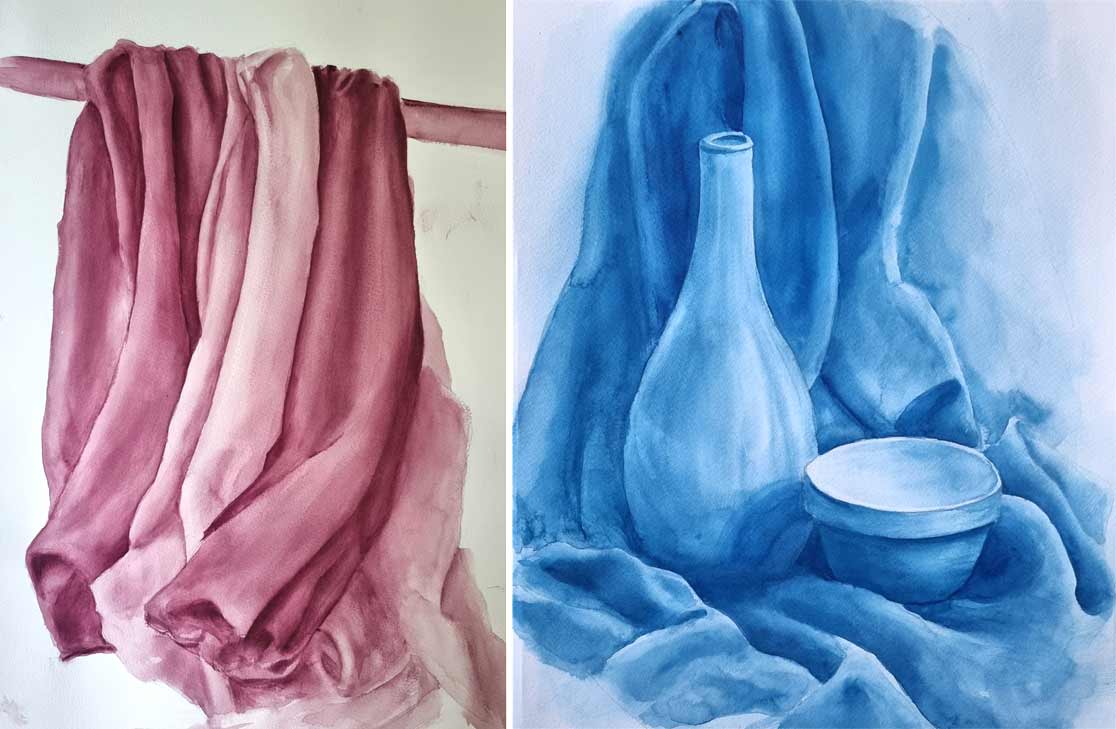
Your monochrome studies are particularly useful in this respect. In the burgundy drapery, you have observed the large vertical folds very well. The alternation of light and shadow gives the fabric volume, and the darker areas between the folds create a convincing sense of depth. I also like the variation between broad, soft passages and more defined edges.
When working on similar studies in the future, you could pay even more attention to the hierarchy of folds. Some folds are structural and determine the overall movement of the fabric, while others are secondary details. Establishing the largest folds first and simplifying smaller ones will make the composition even stronger.
The blue monochrome still life is another successful exercise. Limiting the palette allows you to concentrate on tonal relationships between the bottles, bowl, and surrounding fabric. The objects remain clearly distinguishable despite being painted within the same color family, which demonstrates good control of values
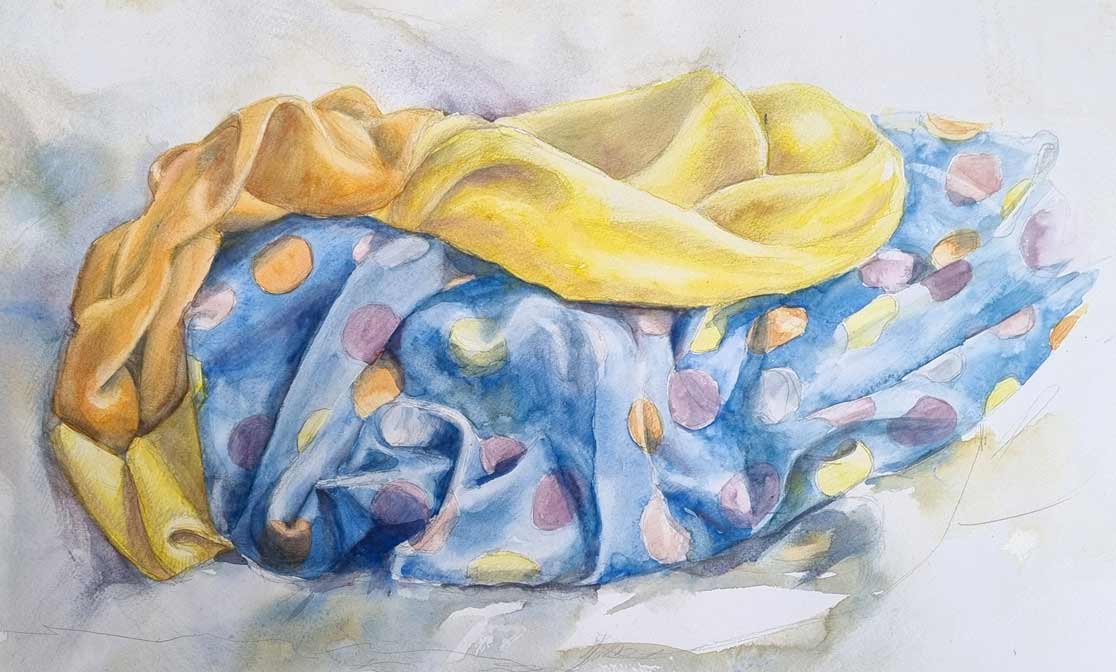
The full-color study with the yellow and blue fabrics introduces a much greater level of complexity. The combination of the warm yellow drapery with the cooler blue patterned cloth is lively and attractive. You have successfully maintained the overall form of the fabric despite the decorative pattern.
One useful point to keep in mind when painting such drapery is that the pattern should always follow the form of the fabric. As the cloth bends, turns, or disappears into a fold, the pattern must also change direction and become compressed or partially hidden. Simplifying the pattern in shadow areas can also help prevent it from competing with the larger structure of the folds.
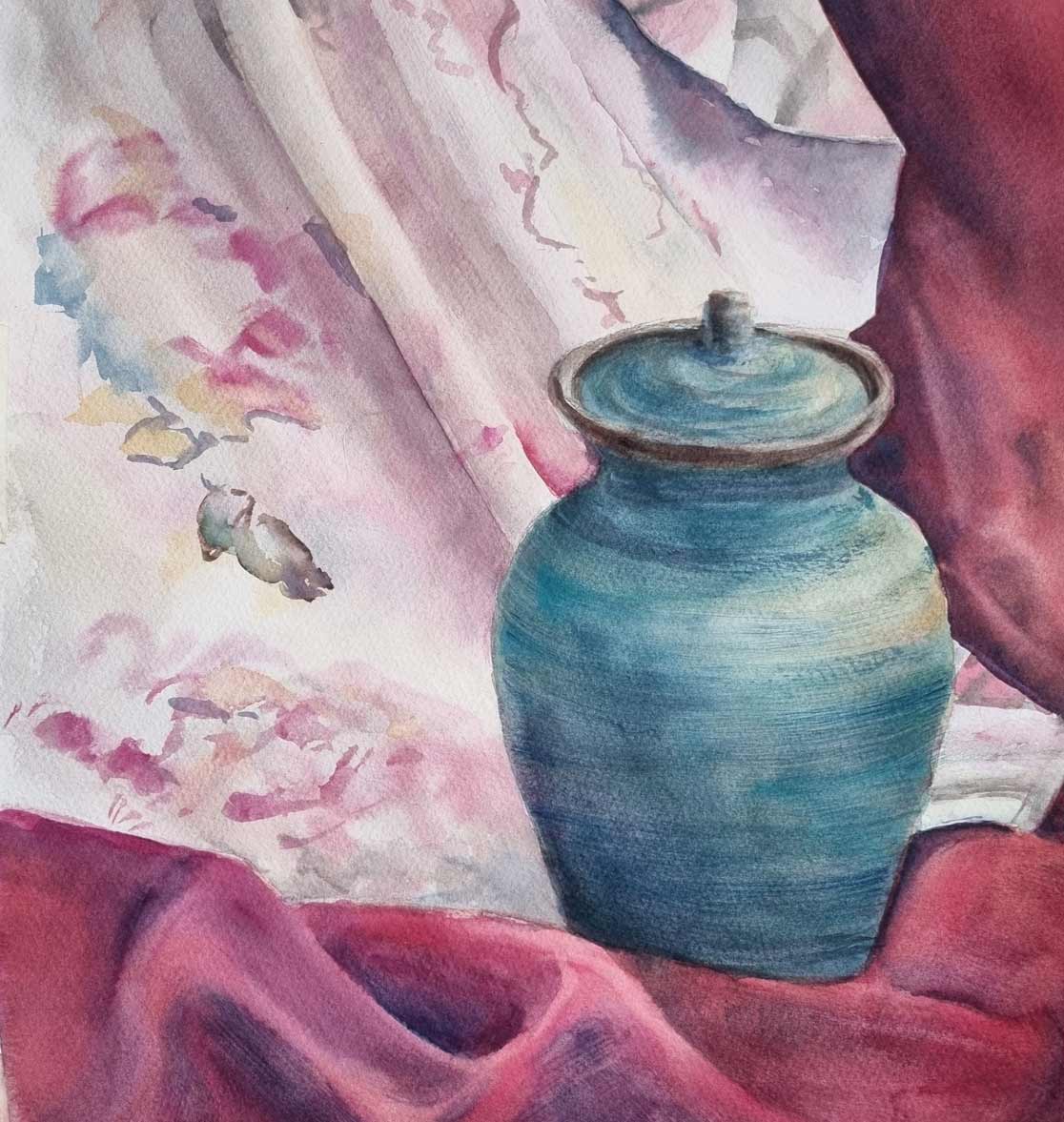
Your still life with the blue-green vessel and red and pale draperies is especially pleasing in its color harmony. The cool vessel creates a strong focal point against the warmer surrounding fabrics. I also like the contrast between the solid, rounded ceramic form and the softer, flowing shapes of the cloth. The vessel has a convincing sense of volume, although the ellipses around the lid and opening could be checked even more carefully. With symmetrical objects, small inaccuracies in an ellipse can become noticeable, so it is always helpful to establish the central axis and construct the ellipses lightly before beginning the watercolor washes.
The fabrics surrounding the vessel are handled sensitively. Some edges dissolve softly into the neighboring colors, while others remain more defined. This variety is very appropriate for watercolor and helps create depth. You could develop this further by reserving the sharpest edges and strongest contrasts for the main focal area and allowing secondary folds to become softer.
Another strength throughout these studies is your willingness to work with both subtle and stronger color relationships. Drapery provides a wonderful opportunity to observe reflected color. A blue object can influence the nearby fabric, just as warm red or yellow cloth can introduce reflected warmth into adjacent shadows. Paying close attention to these color exchanges will make future still lifes even more unified and realistic.
Overall, this is a very successful set of exercises. You are not simply painting pieces of fabric; you are studying form, value, color, edges, rhythm, and spatial relationships at the same time. The monochrome studies demonstrate a good understanding of tonal modeling, while the full-color works show growing confidence in handling more complicated color combinations and patterned materials.
Keep practicing these principles. Drapery is one of those subjects that becomes increasingly rewarding as your understanding develops, and these artworks show very good progress.
Kind regards,
Vladimir London
To learn how to paint in watercolor, enroll now:
Watercolor Academy Online Course
A self-study, self-paced course where you can learn how to paint in watercolor by watching video lessons and doing assignments
- Unlimited access to 80 watercolor painting video lessons
- Lifetime membership without deadlines
- Unlimited support from the Academy tutors
- Constructive critique of your artworks
- Member access to the Academy's Art community
- Place in the Academy's Students Gallery
- Exclusive members-only newsletter and bonuses
- Watercolor Academy Diploma of Excellence in your name
One-time payment - Lifetime membership
$297 USD
ENROLL NOW
Personal Tutoring online + Online Course
One-to-one, unlimited and custom-tailored to your skills and needs Personal Tutoring by the Watercolor Academy teachers
- Everything in Online Course, plus:
- Dedicated team of art tutors
- Assessment of your current level of art skills
- Personalized curriculum tailored to your skills and goals
- Up to 100 art tasks with by-task assessment
- Unlimited one-to-one personal coaching with detailed per-task instructions and feedback
- Artwork critiques and results-oriented guidance
One-time payment - Lifetime membership
$997 USD
ENROLL NOW