Portrait by Gerard, a Watercolor Academy student
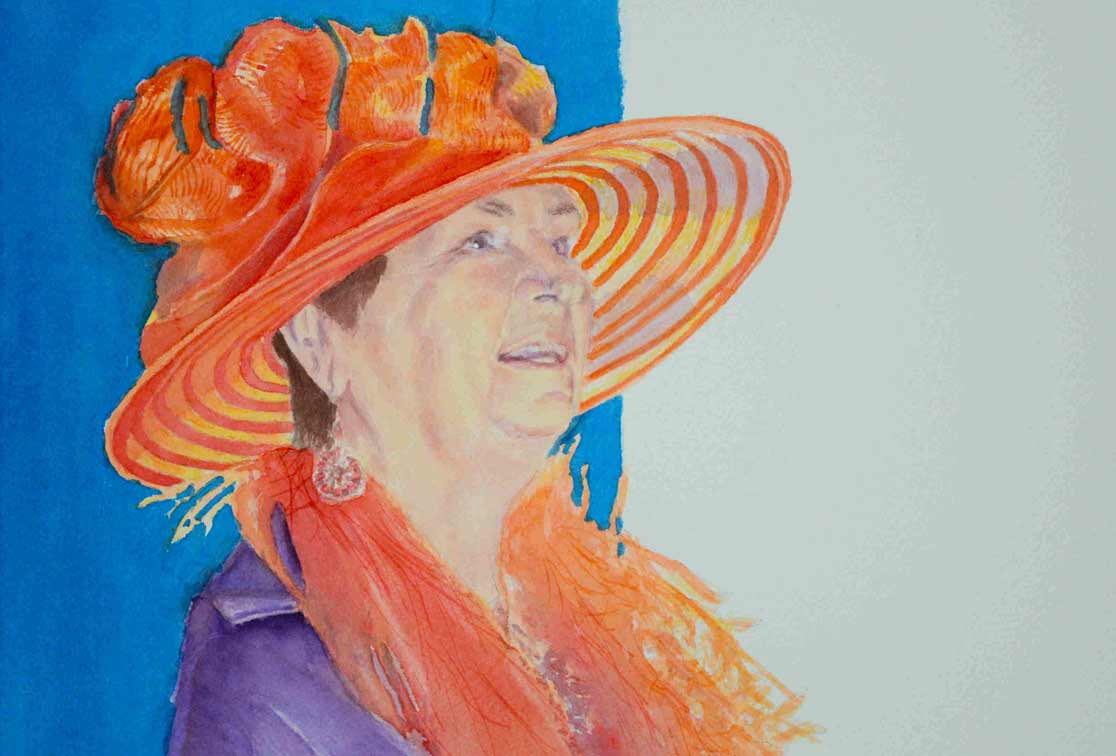
Gerard created this watercolor portrait as a gift for a colleague. He was pleased that the portrait captured her likeness, which was especially important to him. He also experimented with strong complementary colors, using blue-green against yellow-orange, and introduced a sharp graphite pencil into the wet paper to create texture in the boa. Gerard noted that he was satisfied with the result, while also recognizing that the hat and some of the facial shadows could be improved through further practice.
Feedback from Vladimir London, a Watercolor Academy tutor
Dear Gerard,
Thank you for sharing this watercolor portrait. I like this artwork very much, and the first thing that stands out is the strong likeness. The portrait feels individual and recognizable, which is one of the most difficult things to achieve in portrait painting. Hopefully, your colleague will be delighted to receive such a personal gift.
The composition is also successful. Placing the head away from the center makes the arrangement more interesting and avoids a static, symmetrical composition. The large hat creates a strong shape around the face, while the open light area on the right gives the portrait breathing space. The upward direction of the gaze also works well with this open area, because the sitter appears to be looking into the space rather than toward the edge of the picture.
The use of color is bold and memorable. The intense blue background creates a striking contrast with the orange, red, and yellow tones of the hat and scarf. This complementary relationship gives the painting energy and immediately attracts attention.
At the same time, I would consider reducing the strength of this contrast slightly. The blue and orange-red colors are so powerful that they sometimes compete with the face, which should ideally remain the main focal point. You do not necessarily need to change the color scheme itself. The combination is interesting and works well. Instead, you could slightly reduce the saturation or tonal contrast in selected areas around the hat and background. This would allow the viewer's attention to return more naturally to the sitter's face.
The treatment of the face is particularly successful. The watercolor transitions are soft and delicate, with subtle shifts between warm and cool hues. These gentle changes suit the subject very well and give the skin a convincing sense of softness and volume.
This creates an interesting contrast with the hat, which is painted with much sharper contours and stronger linear definition. The brim is especially crisp compared with the softer treatment of the face. If this difference was intentional, it can certainly be considered part of your personal artistic approach. The combination of soft facial modeling and decorative, graphic shapes gives the portrait character.
If, however, you were aiming for greater stylistic unity, you might soften some of the hat's contours and allow selected edges to dissolve into the surrounding colors. Watercolor is especially suitable for creating a variety of edges, from very sharp to almost completely lost. Using this variety deliberately can help direct the viewer's attention. Sharper edges could be reserved for important areas around the face, while less important parts of the hat could become softer.
The top of the hat is perhaps the least resolved area, as you have already noticed yourself. Its construction could be studied more carefully before painting. The crown has a complex three-dimensional form, and establishing its main planes, volume, and relationship to the brim in a preliminary drawing would make the final watercolor more convincing. However, this is exactly the kind of problem that improves through repeated practice.
You also mentioned being cautious about developing the shadows on the face because even a very small change can affect likeness. That is a very good observation. In portraiture, tiny changes in the shape of an eye, the angle of the mouth, the width of the nose, or the boundary between light and shadow can alter the identity of the sitter. It is therefore wise not to overwork a likeness once it has been successfully captured.
At the same time, future studies could explore slightly stronger modeling of the face. Rather than adding many small details, concentrate on the larger planes of the head and the main transitions from light into shadow. This would give the face greater volume while preserving both freshness and likeness.
The graphite work in the boa is also an interesting experimental touch. Combining a sharp pencil with wet watercolor creates a different type of mark and gives the lower part of the portrait additional texture. This kind of experimentation is valuable because it gradually helps an artist discover a personal visual language.
Overall, this is a very successful portrait. The likeness is strong, the composition is engaging, and the color scheme gives the artwork personality. My suggestions about reducing some of the color contrast, varying the edges, and strengthening the construction of the hat are optional refinements rather than corrections of major faults.
Most importantly, the painting already has individuality and confidence. Keep practicing portraiture and experimenting with watercolor techniques. As you have correctly observed, progress comes through repeated practice, and every new portrait gives you another opportunity to refine both your technical skills and your artistic vision.
Kind regards,
Vladimir London
To learn how to paint in watercolor, enroll now:
Watercolor Academy Online Course
A self-study, self-paced course where you can learn how to paint in watercolor by watching video lessons and doing assignments
- Unlimited access to 80 watercolor painting video lessons
- Lifetime membership without deadlines
- Unlimited support from the Academy tutors
- Constructive critique of your artworks
- Member access to the Academy's Art community
- Place in the Academy's Students Gallery
- Exclusive members-only newsletter and bonuses
- Watercolor Academy Diploma of Excellence in your name
One-time payment - Lifetime membership
$297 USD
ENROLL NOW
Personal Tutoring online + Online Course
One-to-one, unlimited and custom-tailored to your skills and needs Personal Tutoring by the Watercolor Academy teachers
- Everything in Online Course, plus:
- Dedicated team of art tutors
- Assessment of your current level of art skills
- Personalized curriculum tailored to your skills and goals
- Up to 100 art tasks with by-task assessment
- Unlimited one-to-one personal coaching with detailed per-task instructions and feedback
- Artwork critiques and results-oriented guidance
One-time payment - Lifetime membership
$997 USD
ENROLL NOW