Watercolor Academy Online Course
A self-study, self-paced course where you can learn how to paint in watercolor by watching video lessons and doing assignments
$297 USD
ENROLL NOWA self-study, self-paced course where you can learn how to paint in watercolor by watching video lessons and doing assignments
$297 USD
ENROLL NOWOne-to-one, unlimited and custom-tailored to your skills and needs Personal Tutoring by the Watercolor Academy teachers
$997 USD
ENROLL NOWExciting news! Our art tutor, Natalie Richy, has won a medal at the VIII Caudete International Watercolor Biennale in Spain!
This year's biennale celebrates experimental approaches and innovations in watercolor painting. Natalie received the medal for her painting Self-Portrait with a Mirror. Measuring 75 × 56 cm, the artwork was created on 100% cotton paper using watercolor and cold-wax tempera, a beeswax-based medium inspired by ancient painting traditions.
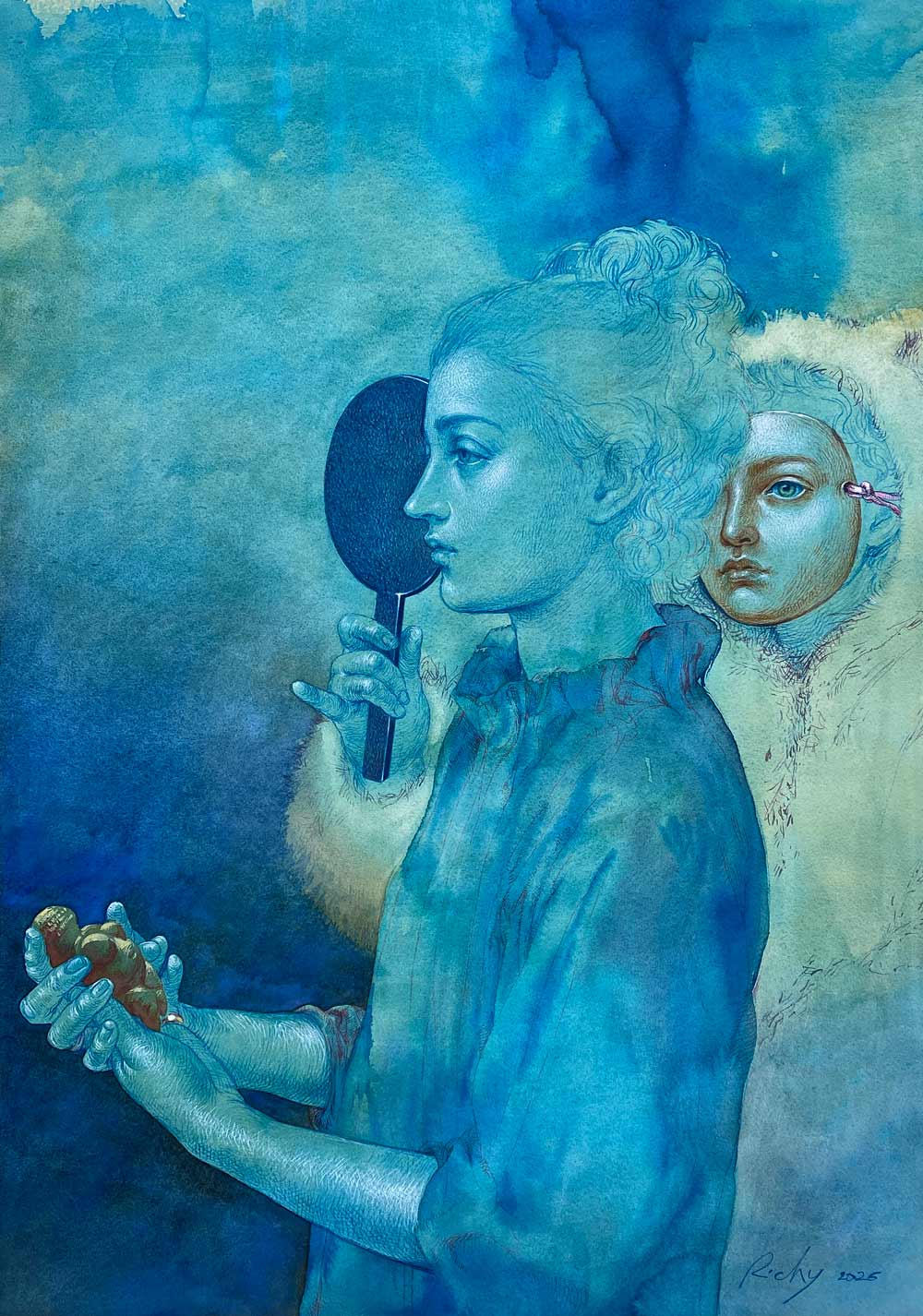
Congratulations, Natalie! We're so happy for you! You're a talented artist and a great teacher, and it's lovely to see your work recognized. We wish you and all your students many more beautiful paintings and exciting opportunities to explore new artistic ideas!
With love and best wishes,
Your friends at Watercolor Academy and Old Masters Academy
Natalie Richy's Self-Portrait with a Mirror brings together the fluid qualities of watercolor and the controlled brushwork possible with cold-wax tempera. The latter uses a beeswax emulsion related to historical preparations commonly associated with Punic wax.
By combining these two techniques, Natalie achieved a contrast between delicate, carefully hatched brushstrokes and the natural flow of watercolor washes.
Ancient writers described methods of preparing wax for artistic use. Today, artists can explore similar materials using modern wax emulsions. Unlike natural beeswax, which does not dissolve in water, these preparations can be mixed with water and combined with pigments. This is achieved by treating or blending beeswax with suitable emulsifying substances, including soap or alkaline agents.
The resulting paint can be applied with ordinary brushes at room temperature. It does not require the heating used in traditional encaustic painting, making cold-wax tempera a distinct technique rather than a form of hot encaustic.
The history of wax painting reaches back to classical antiquity. Its possible role in the wall paintings of Pompeii and the Fayum mummy portraits of Roman Egypt continues to interest art historians and conservation scientists. While the exact composition of some ancient paints remains uncertain, modern reconstructions provide valuable ways to explore these historical materials.
Wax emulsions can produce translucent color and distinctive surface effects. Their compatibility with water-based paints also makes them useful alongside watercolor.
In Self-Portrait with a Mirror, Natalie uses these properties to develop finely detailed passages with delicate hatching, contrasted with loose watercolor washes. The different handling qualities of the two media give the painting its visual richness.
Natalie's continued exploration of historical painting materials reflects her interest in adapting traditional methods to contemporary figurative art. Her work shows how techniques associated with the distant past can still offer fresh possibilities for painters today.
A self-study, self-paced course where you can learn how to paint in watercolor by watching video lessons and doing assignments
One-time payment - Lifetime membership
$297 USD
One-to-one, unlimited and custom-tailored to your skills and needs Personal Tutoring by the Watercolor Academy teachers
One-time payment - Lifetime membership
$997 USD